Monday, June 2, 2014

My Investment Record (9) - 1st June 2014

I decided to change the evaluation frequency of my portfolio to monthly evaluation to match GIPS requirement. Seeking compliance to GIPS means i will need to credit the share dividend during the ex-dividend date as well to my portfolio.
________________________________________________________________________

Market Overview
For the past two months, KLCI gained about 22.5 points. The index broke its historical high of 1887.07 at 19th May 2014, but slowly retreated back to its current level.

Current Return and performance

The holding period return for KLCI in the past period (1st April 2014 - 31st May 2014) is 1.75% (with dividend included). Holding Period return for my portfolio, is 4.64%. Total holding period return for my portfolio since the inception is 16.16%, annualized to be 8.94%, this had more than doubled the Fixed Deposit rate of 3.2-3.8%, but still below KLCI return of 20.86% (annualized, 11.43%). 


Trading Activities

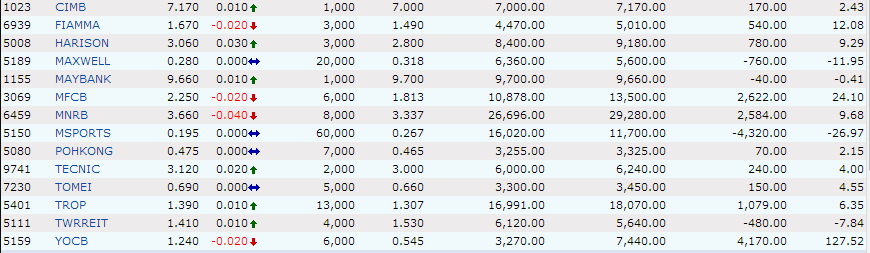
i. Disposal of all TROP (5401). The main reason is that it seems Tropicana Corporation lost its earning growth momentum shown in its lackluster 1st Quarter earning. This coupled with the fact that the current board of directors are paying themselves a huge remuneration package and asking for approval of ESOS again, make me worry that the company had simply became a tool for its major shareholder to accumulate wealth. Thus it would be best if i disposed it while i still earn a profit. 

ii. Disposal of Harrison (5008). The company had been in disputed with Custom over excise taxes which settled recently. However, the settlement will results in one off loss of RM 40 million plus for current financial years. Hence i figure it would be better to sell when the price is high at RM3.40 and bought it back when investors react to the loss later. 

iii. Addition of MNRB (6459). The company posted a strong 4Q result which add up to EPS of about 70 sen for last financial year. With an anticipated minimum 45% dividend payout, and current price about RM4, this translated to dividend yield of close to 8%. Making it a good investment. 


Saturday, April 19, 2014

The Pros and Cons of buying a life insurance

Most people are more familiar with the pros, 

i. Your family get a sum if you accidentally die prematurely or
ii. You get a sum when you faced terminally ill deceases or critical deceases
iii. It can be used by rich to transfer wealth in countries levy inheritance taxes

Etc Etc. 

Few people are familiar with the cons, 
i. Basically for some, they never recoup back the premium they paid to be insured against the risk
ii. It is not an efficient form of investment, especially for life insurance came with an investment plan, there always be a clause stating that, actual investment return depending on the fund managers performance.
iii. If you can keep paying the premium, you keep enjoying the benefit. But once you failed to make payment once, you forgo everything you accumulate in the past. 
iv. It literally follow the contract wording when came to decide the payout. And, most of the people who buy the life insurance, actually don't know the difference between type of diseases cover, or structure of payments. 

Last but a few, 
i. In malaysia where no inheritance taxes are levied, it matters less if you can used the life insurance to transfer the wealth. (although we do have tax exemption for life insurance, the amount exempted is combined with EPF contribution, which means when EPF contributions exceed RM6,000 per year, you receive no tax exemption for amount pay for life insurance.)

ii. If your family don't need you to leave a bequest, then you have no need to buy a life insurance. 

iii. Some big corporations do provide group life insurance, you can check whether you need to go for beyond. 


Monday, April 14, 2014

Writing one Investment Policy Statement (First Trial)

The Investment Policy Statement (IPS) , define one return and risk objective, while listing down all the relevant constraints (time horizon, taxation, liquidity requirement, legal, and other unique requirement). This will subsequently determine what portfolio can be invested into in the Strategic Asset Allocation (SAA).

Few assumptions:

i. Malaysia Inflation Rate to be 2.5% per year. (last 10 years average, 2.38% see calculation here.)
ii. Salary to be rise at 5% per year. 
iii. required living expense per month to live comfortably = RM 2,000 in current ringgit. 
iv. Malaysia income tax rate unchanged. 
v. EPF average return to be 5% per year. 
vi. Life expectancy to be 85 years. 
vii. Will retire at 60 years, as current statutory minimum retirement age. 

__________________________________________________________

The first thing to know, is to calculate how much you need to sustain the living standard for 25 years after retirement.

This can be done by summing the Present Value (PV) of all future expense at age 60. 
I figure i would need RM 4631 per month starting age 60 for minimum standard of living (equivalent to RM 2000 that current ringgit value and 2.5% inflation rate). 
This translate to RM 55568 for the first year, and total PV of next 25 years expense to be RM 1.05 million (assuming constant rate of return of 5% in EPF) 

Ie, i would need to have RM 1.05 million by the age of 60 to ensure enough saving for retirement. 

I figure if my current salary to keep rising at 5% per year and EPF rate of return to be 5% per year, i would have roughly RM2.2 million by age of 60. Which means, except regular EPF contribution, i do not need to save anything now from my current salary. 
_________________________________

Hence my IPS will be

Return Objective : after tax 5% per year (nominal) 
Risk Objective: 
Ability to take risk - High ( as i am currently still young , with stable income to sustain living)
Willingness to take risk - High

Constraints: 
Time Horizon - Long (more than 15 years)
Tax consideration - as Malaysia dont tax capital gain nor dividend income, there is less concern here. 
Liquidity requirement - Not applicable for the moment. ( or one month expense to sustain living until next salary banked in)
Legal - Not applicable for the moment. 
Unique requirement - Not applicable for the moment. 

________________________________

Things will get complicated when I need to save for marriage, save for first home, save for emergency medical fund when i get old, save for some desires in my life etc. This will be address later when i subsequently revised my IPS and setting saving goals. 


calculating Inflation Rate for Malaysia

First, the inflation rate can be calculated from consumer price index as,
Inflation rate for year 2000 = consumer price index at year 2000/consumer price index at year 1999.

Time series data for Malaysia Consumer Price Index can be obtain for free at malaysia department of statistic website here.

The results is in the table below.

Few implications,

i. Inflation rate usually rise when economy is booming, fall when economy is in recession.
ii. Average inflation for past 10 years (2.38%) is lower than 32 years average (2.98%), suggesting a slowing down of inflation as economy expanding in the age of globalization.
iii. when inflation rate is at 2.38% average,
Real interest rate = nominal interest rate - inflation rate stood at below 1%.
Keeping money in fixed deposit or buying government bond for long term is not a particular good choice.


Saturday, March 29, 2014

My Investment Record (8) - 30 March 2014

Market Overview


The market went through a bumpy road for the past month. News like MH370 went missing and Crimea referendum to join Russia periodically shock the market and creating buying opportunity for investors. However, over the long run, strong recovery in US and Europe and slowing down of China Economy will be two opposite theme that shape the future of the market. 

Current Return and performance

The holding period return for KLCI in the past period (1st March 2014 - 30th March 2014) is 1.09% (with dividend included). Holding Period return for my portfolio, is -0.50%. Total holding period return for my portfolio since the inception is 10.76%, annualized to be 6.66%, this is significantly above the Fixed Deposit rate of 3.2-3.8%, but still way below KLCI return of 18.78% (annualized, 11.48%). 


Trading Activities

Addition of  CIMB (1023) and Maybank (1155), Banking would be the sector that have least chance of going out of business. At low P/E (12- 13) and high yield (approx 3.5% for CIMB and 6% for Maybank), the price seems attractive for me. 


Friday, February 28, 2014

Learning from Mr. Money Mustache

The story of Mr. Money Mustache is not easily replicated in Malaysia.

He start with a Software Engineer job with salary $40,000 and eventually earn up to $120,000 per year.
He can keep his annual expense down to within $25,000, thanks to the buying power of US dollar.
He lived in a small town, where people can actually buy a 3 bedrooms house for less than $100,000.

In malaysia, it would be difficult for youths to earn up to RM120,000 per year at their earlier thirties.
Even if they can keep their expense down to within RM 25,000, this would mean no long distance travelling, for a family of three. Thanks to the low buying power of Malaysia Ringgit.
And everywhere, a 3 bedrooms house will certainly cost you more than RM 200,000.

The only advantages we have over US, is that we generally pay lower taxes (no capital gain tax especially).
_____________________________

But the philosophy remain the same, if we want to retire earlier, achieve financial freedom and enjoy our life, living the way we want when we are not born as son/daughter of Robert Kuok.

Save at least 50% of your salary by
Cutting down unnecessary expense such as
i. Fancy Smartphone and Data plan
ii. Imported Car
iii. Dining out , whether in expensive restaurant or mamak stall.
iv. Clothings and other expensive staff

You can share house rent, utilities bills, internet, even car pooling with friends.

And then invest all your savings into blue chips equities or paying down your mortgage.
Invest regularly, hold the blue chip stocks, dont try to time the market.

You will be surprised how fast you can gain the most precious gifts in your life, the financial freedom.

This Forbes Interview is a good read for any of you who are interested to his story.
http://www.forbes.com/sites/laurashin/2013/10/03/how-mr-money-mustache-retired-at-age-30-and-how-you-can-too/


My Investment Record (7) - 28 February 2014

I will evaluate my portfolio performance on two occasions, one when it is the end of quarter (1st April, 1st July, 1st Oct, 1st Jan), the other when i inject new capital into the portfolio, hence the need to calculate and record the holding period return for the period before. 

Market Overview

For the past month, KLCI index was lifted by the release of quarterly financial results of blue chip companies, which display general trend of increasing profit. Global market remain cautiously optimistic, with S&P 500 touching historical peaks several times last week, while investors watch carefully how China Economic slowing down itself. 

Current Return and performance

The holding period return for KLCI in the past period (1st Feb 2014 - 28th Feb 2014) is 2.03% (with dividend included). Holding Period return for my portfolio, is 5.75%. Total holding period return for my portfolio since the inception is 11.21%, annualized to be 7.34%, this had double the Fixed Deposit rate of 3.2-3.8%, but still way below KLCI return of 17.50% (annualized, 11.35%). 

This is the third out of seven times in evaluation period that my portfolio performance beat the general market. Luck certainly play a part where few of the stocks i picked jumped up high during past month. I will be cautiously optimistic that i can beat the market again for the next evaluation period. As general stock market stay at higher level, it will become increasingly harder to spot a few bargain stocks. 

Trading Activities

i. Addition of TROP (5401). As stated in previous post, with unbilled sales close to RM2 billion and profit from two sales of land lots  reflected in TROP financial statements, Revenue, Profit and NAV of the company keep growing strong. The only concern now, is whether Tropicana Corporation can generate enough Capital to support Tan Sri Danny Tan ambitious expansion plan before he decided to undertake other private placement of shares at a discount to NAV, often at the expense of existing shareholders.