Monday, April 14, 2014

Writing one Investment Policy Statement (First Trial)

The Investment Policy Statement (IPS) , define one return and risk objective, while listing down all the relevant constraints (time horizon, taxation, liquidity requirement, legal, and other unique requirement). This will subsequently determine what portfolio can be invested into in the Strategic Asset Allocation (SAA).

Few assumptions:

i. Malaysia Inflation Rate to be 2.5% per year. (last 10 years average, 2.38% see calculation here.)
ii. Salary to be rise at 5% per year. 
iii. required living expense per month to live comfortably = RM 2,000 in current ringgit. 
iv. Malaysia income tax rate unchanged. 
v. EPF average return to be 5% per year. 
vi. Life expectancy to be 85 years. 
vii. Will retire at 60 years, as current statutory minimum retirement age. 

__________________________________________________________

The first thing to know, is to calculate how much you need to sustain the living standard for 25 years after retirement.

This can be done by summing the Present Value (PV) of all future expense at age 60. 
I figure i would need RM 4631 per month starting age 60 for minimum standard of living (equivalent to RM 2000 that current ringgit value and 2.5% inflation rate). 
This translate to RM 55568 for the first year, and total PV of next 25 years expense to be RM 1.05 million (assuming constant rate of return of 5% in EPF) 

Ie, i would need to have RM 1.05 million by the age of 60 to ensure enough saving for retirement. 

I figure if my current salary to keep rising at 5% per year and EPF rate of return to be 5% per year, i would have roughly RM2.2 million by age of 60. Which means, except regular EPF contribution, i do not need to save anything now from my current salary. 
_________________________________

Hence my IPS will be

Return Objective : after tax 5% per year (nominal) 
Risk Objective: 
Ability to take risk - High ( as i am currently still young , with stable income to sustain living)
Willingness to take risk - High

Constraints: 
Time Horizon - Long (more than 15 years)
Tax consideration - as Malaysia dont tax capital gain nor dividend income, there is less concern here. 
Liquidity requirement - Not applicable for the moment. ( or one month expense to sustain living until next salary banked in)
Legal - Not applicable for the moment. 
Unique requirement - Not applicable for the moment. 

________________________________

Things will get complicated when I need to save for marriage, save for first home, save for emergency medical fund when i get old, save for some desires in my life etc. This will be address later when i subsequently revised my IPS and setting saving goals. 


calculating Inflation Rate for Malaysia

First, the inflation rate can be calculated from consumer price index as,
Inflation rate for year 2000 = consumer price index at year 2000/consumer price index at year 1999.

Time series data for Malaysia Consumer Price Index can be obtain for free at malaysia department of statistic website here.

The results is in the table below.

Few implications,

i. Inflation rate usually rise when economy is booming, fall when economy is in recession.
ii. Average inflation for past 10 years (2.38%) is lower than 32 years average (2.98%), suggesting a slowing down of inflation as economy expanding in the age of globalization.
iii. when inflation rate is at 2.38% average,
Real interest rate = nominal interest rate - inflation rate stood at below 1%.
Keeping money in fixed deposit or buying government bond for long term is not a particular good choice.


Saturday, March 29, 2014

My Investment Record (8) - 30 March 2014

Market Overview


The market went through a bumpy road for the past month. News like MH370 went missing and Crimea referendum to join Russia periodically shock the market and creating buying opportunity for investors. However, over the long run, strong recovery in US and Europe and slowing down of China Economy will be two opposite theme that shape the future of the market. 

Current Return and performance

The holding period return for KLCI in the past period (1st March 2014 - 30th March 2014) is 1.09% (with dividend included). Holding Period return for my portfolio, is -0.50%. Total holding period return for my portfolio since the inception is 10.76%annualized to be 6.66%this is significantly above the Fixed Deposit rate of 3.2-3.8%, but still way below KLCI return of 18.78% (annualized, 11.48%). 


Trading Activities

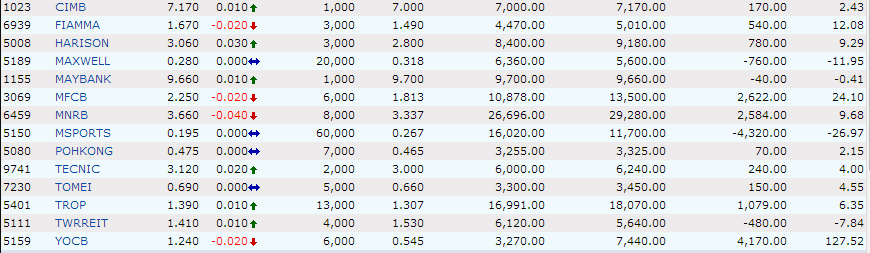
Addition of  CIMB (1023) and Maybank (1155), Banking would be the sector that have least chance of going out of business. At low P/E (12- 13) and high yield (approx 3.5% for CIMB and 6% for Maybank), the price seems attractive for me. 


Friday, February 28, 2014

Learning from Mr. Money Mustache

The story of Mr. Money Mustache is not easily replicated in Malaysia.

He start with a Software Engineer job with salary $40,000 and eventually earn up to $120,000 per year.
He can keep his annual expense down to within $25,000, thanks to the buying power of US dollar.
He lived in a small town, where people can actually buy a 3 bedrooms house for less than $100,000.

In malaysia, it would be difficult for youths to earn up to RM120,000 per year at their earlier thirties.
Even if they can keep their expense down to within RM 25,000, this would mean no long distance travelling, for a family of three. Thanks to the low buying power of Malaysia Ringgit.
And everywhere, a 3 bedrooms house will certainly cost you more than RM 200,000.

The only advantages we have over US, is that we generally pay lower taxes (no capital gain tax especially).
_____________________________

But the philosophy remain the same, if we want to retire earlier, achieve financial freedom and enjoy our life, living the way we want when we are not born as son/daughter of Robert Kuok.

Save at least 50% of your salary by
Cutting down unnecessary expense such as
i. Fancy Smartphone and Data plan
ii. Imported Car
iii. Dining out , whether in expensive restaurant or mamak stall.
iv. Clothings and other expensive staff

You can share house rent, utilities bills, internet, even car pooling with friends.

And then invest all your savings into blue chips equities or paying down your mortgage.
Invest regularly, hold the blue chip stocks, dont try to time the market.

You will be surprised how fast you can gain the most precious gifts in your life, the financial freedom.

This Forbes Interview is a good read for any of you who are interested to his story.
http://www.forbes.com/sites/laurashin/2013/10/03/how-mr-money-mustache-retired-at-age-30-and-how-you-can-too/


My Investment Record (7) - 28 February 2014

I will evaluate my portfolio performance on two occasions, one when it is the end of quarter (1st April, 1st July, 1st Oct, 1st Jan), the other when i inject new capital into the portfolio, hence the need to calculate and record the holding period return for the period before. 

Market Overview

For the past month, KLCI index was lifted by the release of quarterly financial results of blue chip companies, which display general trend of increasing profit. Global market remain cautiously optimistic, with S&P 500 touching historical peaks several times last week, while investors watch carefully how China Economic slowing down itself. 

Current Return and performance

The holding period return for KLCI in the past period (1st Feb 2014 - 28th Feb 2014) is 2.03% (with dividend included). Holding Period return for my portfolio, is 5.75%. Total holding period return for my portfolio since the inception is 11.21%annualized to be 7.34%this had double the Fixed Deposit rate of 3.2-3.8%, but still way below KLCI return of 17.50% (annualized, 11.35%). 

This is the third out of seven times in evaluation period that my portfolio performance beat the general market. Luck certainly play a part where few of the stocks i picked jumped up high during past month. I will be cautiously optimistic that i can beat the market again for the next evaluation period. As general stock market stay at higher level, it will become increasingly harder to spot a few bargain stocks. 

Trading Activities

i. Addition oTROP (5401). As stated in previous post, with unbilled sales close to RM2 billion and profit from two sales of land lots  reflected in TROP financial statements, Revenue, Profit and NAV of the company keep growing strong. The only concern now, is whether Tropicana Corporation can generate enough Capital to support Tan Sri Danny Tan ambitious expansion plan before he decided to undertake other private placement of shares at a discount to NAV, often at the expense of existing shareholders


Sunday, February 23, 2014

Watching 1MDB (part 2) : Its loan structure and its venture into Energy Business

Lack of Transparency
1MDB financial accounts are reported to be audited by KPMG. However, as it is still privately held company, its annual audited accounts are not available to general public. Thus we can only guess its profit and loss figure through all publicized news.

1MDB Loans
1MDB had at least place three placement of loans,
The first, RM 5 billion , 30 years bond issued at coupon rate of 5.75% around May 2009.
Annual coupon payment = RM287.5 million (Source)(source 2)

The second, USD 1.75 billion, 10 years notes issued at yield of 6%,(source) around June 2012
I am guessing its coupon rate to be somewhat 5% - 5.5% (for different in coupon rate and yield rate, please see my other post if i got time to write about).
This amount to annual coupon payment = 87.5 million to 96.3 million USD or RM 288.3 to 317.1 million.

The third, USD 3 billion , 10 years notes issued at yield of 4.4% (source) around March 2013.
It is not clear whether the 4.4% stated in the news is yield or coupon rate,
I am guessing its coupon rate to be some what 4.5% to 5%.
This amount to annual coupon payment = USD 135 million to 150 million or RM 444.8 to 494.2 million.

This mean, 1MDB need to generate at least RM 1.02 to 1.10 billion just to service its debt, under the circumstance that ringgit do not fall further against USD.

1MDB Energy Business
In total 1MDB had three important power assets

The first, Powertek formally owned by Ananda Krishnan,
1 MDB reportedly paying RM 8.5 billion for the deal (source) which has net asset with face value at RM 3.5 billion (source)
The latest profit after tax and minority interest for Powertek at 2012 amount to RM 456 million.
However, we will be more interesting in cash flow ( please see my other post if i got time to write about regarding different in cash flow and net profit).
With total asset at RM 9.04 billion, i am guessing the annual depreciation charge for Powertek is 452 million (assuming 20 years remaining life).
This brings total cash flow to  RM 908 million.

The second, Genting Sanyen (mainly Kuala Langat Power Station)
1 MDB reportedly paying RM 2.3 billion for the deal. Where the asset is debt free.
Guessing the annual cash flow from the asset could be tricky, i am guessing the figure to be around RM 400 million (from the difference of EBITDA figure between year 2012 and year 2011 for Genting Bhd Power segment).

The third, Jimah Power Plant,
1 MDB reportedly paying RM 1.2 billion for the deal, where the amount is small as the project is actually highly leveraged that, the owner may not see any dividend in the first half of the PPA period (until 2020 perhaps). Source.

Thus, i am guessing, the annual cash flow from all power plant assets to be around RM 1.3 billion at best, this left  RM 200 to 280 million to for repayment of the loan thus far.Not to mention the liabilities originally bear by Power Tek and Jimah (estimate to be RM 10 billion perhaps).

In Summary
If 1MDB do get Track 3B project as speculated, its debt could well be ballooned to over RM 40 billion or remain at RM 30 billion if they go IPO.
The only two major revenue sources for them , would be
i. Tun Razak Financial District Project
ii. 1MDB Power.

Which currently estimated by me can generate enough cash flow to repay 1 % of  1MDB total debt annually.


Watching 1MDB (part 1) - Where Najib's Malaysia Corporation Dream unfold.....

Introduction

1 Malaysia Development Berhad (1MDB) is a strategic development company, wholly-owned by the Government of Malaysia (link). 


It originated from Terengganu Investment Authority (TIA), with the aim of investing billions of ringgit in energy, real estate and hospitality sectors in the country, according to a statement from the Prime Minister’s office (source).


Since the inception of the company, 1MDB had been going through rapid expansion, including purchase of few notable power assets (Powertek, Genting Sanyen, Jimah) and undertake large commercial property development project (Tun Razak Exchange)


The Questions for Us

I didn't know the rationale behind Najib Govt's ambitious Malaysia Corporation Set-up. 
Maybe, 
They believe a sovereign-back company, can obtain lower borrowing cost for fund to finance  big project (like track 3B Coal Fire Power Plant or Global Financial District), thus benefit Malaysians in the end?

Maybe, 
They believe a sovereign-back company, can easily get govt to govt cooperation with other country like Middle East, China, Japan, thus bringing in huge amount of FDI into malaysia? 

Maybe, 
They believe by utilizing govt resource and support (land bank, govt to govt agreement, bond guarantee), they can build a profitable conglomerate, thus creating extra source of income for the treasuries (just like Khazanah)

Maybe, 
It is just a vehicle for Najib to bail out/cash out the cronies? 

But since this is a conglomerate own by Malaysia Govt that getting bigger and bigger, every Malaysian should be concern on the outcome of Najib's Govt Business adventure, especially in the following ways

i. How does the growing of 1MDB influences the private sector business and markets?
Will it crowd out private investment in energy sector?
Will it affects profitability of commercial property market and hospitability market? 

ii. How does the presence of 1MDB affect other Govt policy and Central Bank policy? 
As 1MDB undertake a huge commercial property project code name Tun Razak Exchange, 
Will it make govt and central bank more hesitate when introducing measures to cool off the properties market? 

iii. Can 1MDB achieves profitability not only in accounting term but also in economic term, that eventually govt need not bailing out/ repay their bond / injecting assets? 

iv. When 1MDB is getting bigger and bigger, hows their key management personnels selected and paid? 

The Thought
i don't particularly like Najib's idea of setting up a Malaysia Corporation, the real issue is, when the company is fully owned by Govt of Malaysia, the management of the company get a blank check in trying out all sort of business venture, without careful consideration of whether the business venture can generate adequate profit.

Hence, you see people with lack of experience venturing into the energy industry and commercial properties market, we will see a corporation that growing too big too fast, that its organization structure and good governance dont have enough time to develop, thus causing wastage, and rainfall profit for others doing business with them (like Ananda Krishnan, Goldman Sach and Negeri Sembilan Royal Family)

And when Govt extend its presence in private sector, you will see a government with increasing power,
which is not a good sign when you dont believe they can handle it....